
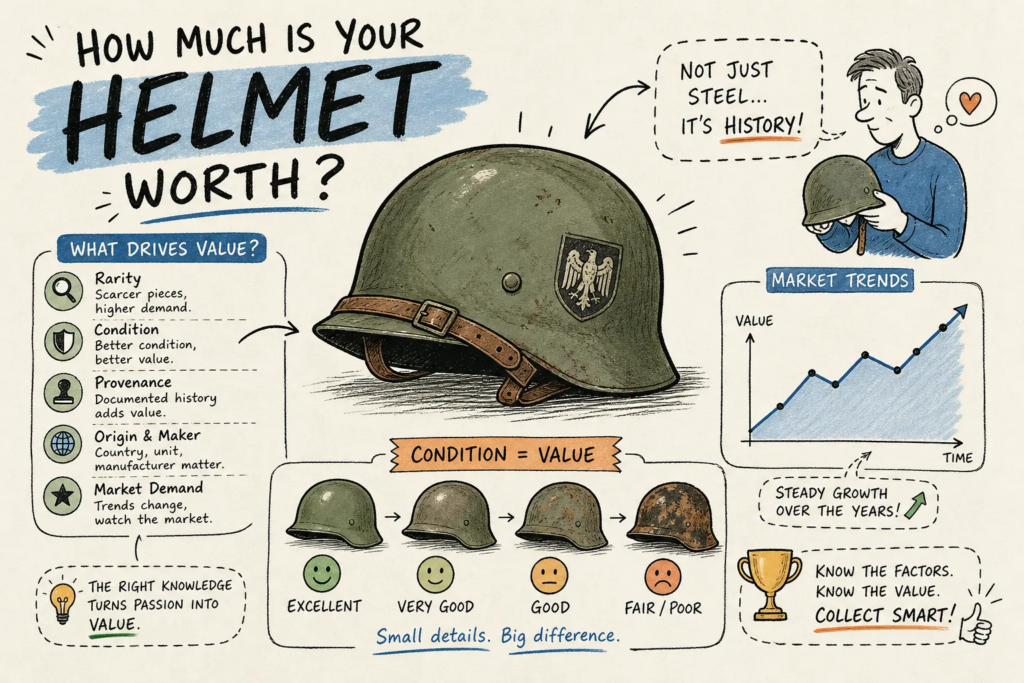
Five factors determine what an antique military helmet is worth: type, era, originality, condition, and documented provenance. Everything in between depends on how well you can read the specific helmet in front of you, the shell, liner, chinstrap, paint texture, and stamps all contribute to the picture. At Antique Armory, every helmet we list is physically appraised and documented before it reaches a buyer, and that level of accountability is the standard every serious collector should demand from any source.
Key takeaways
- Five factors drive value: Type, era, originality, condition, and documented provenance together determine what a militaria helmet sells for in 2026.
- No single feature proves authenticity: Read the whole helmet, shell, liner, chinstrap, paint, and stamps, as a consistent unit.
- Do as little as possible: Minimal, reversible intervention is the right conservation approach. Cleaning can destroy value permanently.
- Demand a written return guarantee: No provenance story, however compelling, replaces a written inspection period and return right on any significant purchase.
What types of antique military helmets actually hold collector value?
Not all helmets command equal interest. Rarity, design history, and battlefield significance drive demand, and national origin matters as much as condition. The types below represent the core categories where collector activity, and collector risk, is highest.
WWI helmets: the M1917 Doughboy and British Brodie
The American M1917 was derived directly from the British Brodie design, and both were produced in enormous quantities. That volume means common examples are relatively affordable, but it also means condition does the heavy lifting on price.
How to value your antique military helmet: WWII American M1 production evolution
The M1 went through two major production phases. Fixed chinstrap bails indicate roughly 1941 to 1943 manufacture; swivel bails arrived during 1943 and continued afterward. A shell and liner that match by manufacturer and production period, what collectors call a “matched” M1, commands a meaningful premium over a wartime shell fitted with a later liner. Heat stamps inside the front flare of the shell help identify the maker: McCord shells carry a lot number and lift letter, Schlueter shells add a prominent “S,” and Parish Reading shells use a P-prefix stamp near the bail. These manufacturer heat-stamp conventions are documented in standard M1 helmet production references and resources such as Military Trader.
German Stahlhelm variants: M35, M40, and M42
The M35 has separate pressed vent grommets and a smooth inward-rolled rim. The M40 retains the rolled rim but stamps the vents directly into the steel with no separate grommet. The M42 eliminates the rolled rim entirely, leaving a raw, slightly flared edge that reduced production time. These construction details are documented in specialist references on German Stahlhelm variants. Decal standards followed a similar simplification: M35s often carried double decals, M40s a single decal, and M42s were typically issued without decals as standard. The M35, particularly with preserved paint and both decals intact, is generally the most valuable of the three. The M42 is the most accessible entry point for newer collectors.
How do you read an antique military helmet to tell if it’s original?
Identification is a skill built on specific, consistent details. No single marking proves authenticity, the helmet must tell a coherent story across every component, from the shell construction to the liner hardware to the aging of its paint.
Cracking the WWII M1: seam, bails, stamps, and paint texture
Start with the rim seam. A front-seam rim generally indicates earlier production; a rear seam suggests later wartime or postwar manufacture. Check whether the bails are fixed or swivel, then look inside the front flare for the heat stamp. Confirm the paint texture: wartime shells typically have a coarse, irregular cork-aggregate finish. A fine, uniform sandpaper-like texture is more characteristic of postwar refurbishment. A repainted shell is not automatically a fake, but it is not an untouched wartime example, and the price should reflect that.
Reading a German helmet: manufacturer codes, vent holes, and decal construction
The rear-skirt stamp, using manufacturer codes such as ET, Q, or SE, identifies the maker and size. It should look aged, not laser-sharp or freshly etched. Vent hole shape varies by model and manufacturer and should match the claimed type. For decals, the warning signs are obvious: a glossy, pixelated, or bubbled decal sitting on top of a modern clear coat is a reproduction regardless of how convincing the shell looks underneath.
Liner and chinstrap: the components most often swapped
The liner is the single most frequently replaced component in both M1 and German helmets. A wartime M1 liner has high-pressure fiber construction, cotton web suspension, and a leather sweatband. A 1960s button-in liner with synthetic webbing and plastic hardware tells you the helmet is a mixed-period piece. German helmets face a specific problem: incorrect Norwegian postwar liners are frequently found in shells sold as fully original. A wrong liner on an otherwise correct shell signals a composite helmet; price it accordingly.
What’s your military helmet actually worth right now?
The 2026 market rewards originality and penalizes anything enhanced after the fact. Use this table as a realistic baseline, not a guarantee.
What moves a helmet’s value up or down
Intact original paint, verified maker stamps, a matching liner, and documented provenance, bring-back papers, photographs, or discharge documents, all push a helmet above the baseline range. Unit markings, when genuine, add further premium. On the other side, visible repainting, a replaced liner, a reproduction decal, absent hardware, and “combat wear” that looks artificially applied all kill value fast. Auction hammer prices run more conservative than dealer asking prices, and a specialist dealer carries a premium for curation and authentication. Many collectors find that premium worthwhile for the confidence it provides on documented pieces.
What red flags should you watch for before buying a collectible combat helmet?
The most common fakes are not entirely new helmets. They are original shells repainted and fitted with reproduction decals, then sold with an inflated story.
The most common ways reproductions get past buyers
Watch for implausible wear inconsistencies: a heavily battered shell with a pristine decal, an unworn chinstrap, or corrosion-free hardware is unlikely to represent an untouched wartime configuration. Fantasy SS markings stamped onto plain Heer helmets are a persistent problem.
How to verify provenance before committing to a purchase
Demand a documented chain of ownership. Veteran bring-back papers, discharge documents, or period photographs connecting the specific helmet to a named person all qualify. A vague “Normandy bring-back” story does not. Request complete, unedited photographs of every surface including the rear-skirt stamp, and compare the claimed story against what the physical object actually shows. A written return guarantee with a meaningful inspection period is non-negotiable on any significant purchase. Antique Armory documents and appraises every helmet in its inventory, so buyers can review that documentation before purchasing rather than relying on a seller’s word alone.
Where should you buy or sell a vintage military helmet?
For serious collectors, a dealer who physically appraises every piece before listing it offers something a general auction platform cannot: accountability and expertise of military helmets for sale.
Buying from authenticated dealers versus auction platforms
Established U.S. specialist dealers such as Advance Guard Militaria and Centurion Auctions, and European houses such as Hermann Historica, represent the broader market. Quality and provenance standards vary across all of them, and each piece should be vetted independently. Antique Armory’s authenticated and appraised listings are built for collectors who want that confidence without sifting through mixed-quality auction lots.
Where to sell an antique military helmet: getting fair value
Gather all documentation before listing. Photograph every marking clearly, including the rear-skirt stamp, the interior liner, and the chinstrap hardware. Understand that matched-component helmets command significantly more than stripped shells. A helmet presented with thorough photographic documentation and any supporting provenance attracts serious buyers and reduces lowball offers. If a militaria helmet for sale carries verified provenance papers, note that prominently, it narrows the field to buyers who recognize the value.
How should you preserve a helmet without destroying its value?
Conservation best practice is to do as little as possible. The most common damage to collectible helmets is not combat. It is well-intentioned cleaning.
Safe handling and what minimal intervention really means
Remove loose dust with a soft natural-hair brush. Never scrub decals, flaking paint, or corrosion crusts. Wear nitrile gloves; finger oils accelerate corrosion on bare steel. If active, spreading rust is present, that is the only condition warranting treatment beyond dry cleaning, and even then a conservator’s assessment is preferable to a DIY acid soak or wire brush. Leave stable patina alone. It can be historically significant and may provide some surface protection.
Storage conditions and what never to put on a metal helmet
Target below 45% relative humidity for most metals, and below 35% for helmets already showing iron corrosion. Avoid silicone products, olive oil, furniture polish, and commercial rust converters. A thin reversible microcrystalline wax applied to a clean, dry surface is acceptable for moisture protection, but waxing over active corrosion seals the damage in. Store on an inert, acid-free support away from direct sunlight and temperature swings.
Buy with your eyes open
An antique military helmet’s value lives in the details most buyers overlook. Reading the seam, the stamps, the liner, and the wear pattern consistently across the whole object is the skill that separates confident collectors from expensive mistakes. Originality is what the 2026 market pays for, anything that looks enhanced after the fact gets discounted fast.
Whether you are buying a first WWI helmet or adding a verified German M35 to an established collection, start with an authenticated source, demand documentation, and never clean before you understand what you have. Antique Armory’s appraised helmet listings come with the documentation and expert authentication that serious collectors should expect as standard, not as a bonus.
Reach out to our team to browse current inventory or ask about a specific piece. We are here to help you buy right the first time.
Frequently Asked Questions
What documentation qualifies as documented provenance for a helmet purchase?
Documented provenance includes veteran bring-back papers, discharge documents, or period photographs that connect the specific helmet to a named person. We warn that a vague story like “Normandy bring-back” does not qualify, and buyers should demand a documented chain of ownership and complete photographs of every surface.
When is it appropriate to do more than dry cleaning on a corroding helmet?
You should only treat beyond dry cleaning if active, spreading rust is present, and then a conservator’s assessment is preferable to DIY methods. We advise against acid soaks, wire brushes, or scrubbing decals and recommend leaving stable patina alone because it can be historically significant.
What photographs should I take if I plan to sell a helmet to get fair value?
Photograph every marking clearly, including the rear-skirt stamp, the interior liner, and the chinstrap hardware. We also recommend complete, unedited photographs of every surface so buyers can verify maker stamps and condition, which attracts serious buyers and reduces lowball offers.