
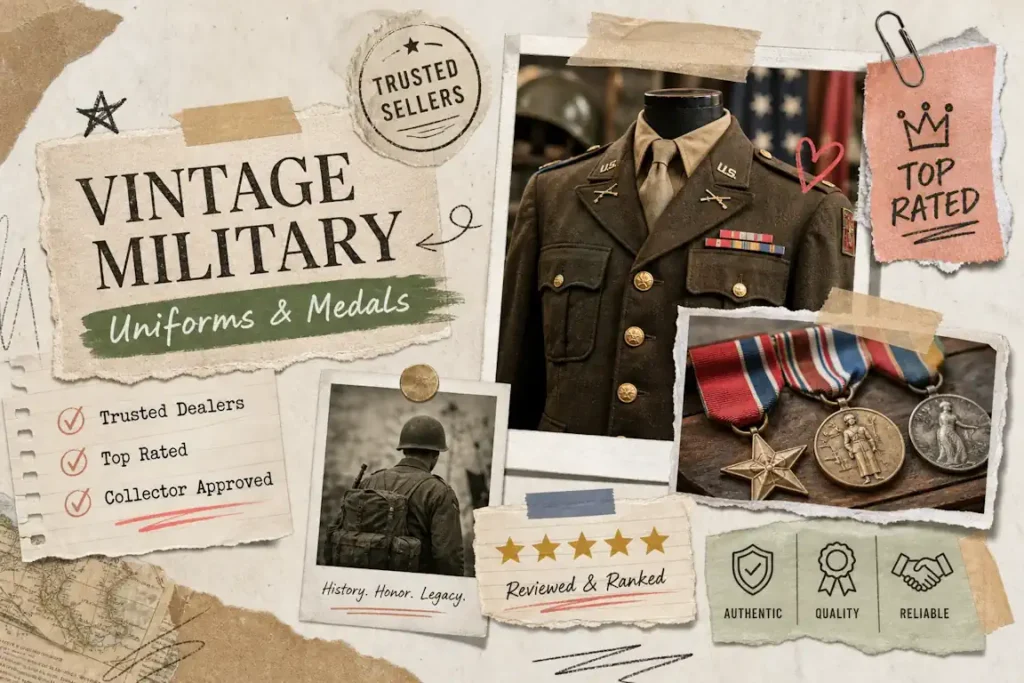
Discover the top dealers for vintage uniforms & medals to expand your collection safely.
The top dealers for vintage military uniforms & medals like auction houses Centurion Auctions, dealers that sell military collectibles like Antique Armory, medal-focused platforms like MedalsOnline, and specialist departments at Heritage Auctions. Each fits a different buyer need, budget, and risk tolerance. Picking the wrong source isn’t just an inconvenience. That’s how collectors end up owning reproductions they can’t resell at a fair price and can’t add with confidence to a serious collection.
This article covers how to pick between these options, what real authentication looks like, what items actually cost by era and category, and what legal tripwires to watch for before you commit to a purchase.
Key takeaways
- Curated dealers first: Authenticated dealers like Antique Armory vet every piece before listing, giving buyers certainty without the complexity of competing bids or buyer’s premiums.
- Auction houses for groupings: Centurion Auctions holds a 4.7/5 rating from 839 LiveAuctioneers reviews and runs recurring militaria catalogues covering named groupings, uniforms, and medals.
- Documentation is essential: A written authenticity guarantee with defined return terms is a baseline requirement. For higher-value purchases, many experienced collectors also seek an independent specialist opinion before committing.
- Provenance multiplies value: Service records, discharge papers, period photographs, and matching uniforms together can raise prices well above what a name alone commands.
- Legal nuances matter: Nazi-era textiles and medals are generally lawful to buy in the United States; firearms, ordnance, and cross-border transactions require separate legal review.
- General marketplaces carry real risk: Etsy and similar platforms are acceptable for low-value accessories, not for named medals, rare groupings, or anything with significant resale potential.
Which online dealers consistently rank best for vintage uniforms and medals?
Centurion Auctions is a leading specialist auctioneer for broad U.S. militaria, covering Civil War through modern conflicts with recurring catalogues that include named groupings, uniforms, medals, insignia, helmets, and archives. Their LiveAuctioneers rating stands at 4.7/5 from 839 verified bidder reviews, with 88% five-star ratings, and customers consistently praise accurate descriptions, careful packaging, and responsive communication. For auction buyers pursuing larger documented collections, this is a strong place to start.
Heritage Auctions carries a BBB A+ rating and runs specialist militaria departments with particularly strong cataloguing for higher-value documented items. Factor in buyer’s premiums and shipping when budgeting; the sticker price at a major auction house is rarely the final cost. MedalsOnline focuses on British and Commonwealth medals, groups, and decorations. Look for listings that include recipient names, service numbers, and citations. Note that their current return terms and authenticity guarantees could not be independently verified at time of writing, so check MedalsOnline’s Terms and Returns pages directly before bidding.
Top online dealers for vintage military uniforms and medals: auction houses vs. curated dealers
For buyers who want certainty without navigating competing bids, buyer’s premiums, or ambiguous condition reports, a curated authenticated dealer is a different kind of confidence entirely. As for our own inventory at Antique Armory, every piece of military memorabilia is authenticated and appraised before it reaches the listing. We carry genuine items spanning World Wars and other conflicts, so you know exactly what you’re getting before the transaction closes. Auction houses sell what consignors bring; we vet what we stock.
General marketplaces like Etsy and LiveAuctioneers (Trustpilot 3.8/5) are useful for affordable common uniforms, insignia, and low-value accessories, but they are not reliable primary sources for named medals, rare groupings, or anything with significant value. Seller ratings alone don’t establish authenticity. Use them as discovery tools, not as trust signals.
How do you verify that a uniform or medal is genuine?
For medals, require clear photographs of the obverse, reverse, suspension, ribbon, edge, naming, and mounting before you commit. Named medals should be cross-referenced against official rolls, casualty databases, and regimental histories. For uniforms, confirm exact measurements, disclosure of alterations, replaced buttons, reproduction insignia, moth damage, and whether the garment is original to its stated period. Vague condition phrases like “excellent for age” or “WWII style” tell you almost nothing useful.
A written authenticity guarantee with defined terms is the minimum standard from any reputable seller. That means a stated duration, clear return conditions, an identified burden of proof, and eligible independent experts. A certificate of authenticity is only as credible as its issuer; an independent specialist’s written opinion adds substantially more weight than a dealer-issued COA. The provenance chain matters too: prior auction catalogues, estate documentation, veteran-family papers, or museum receipts all strengthen the case, and a continuous ownership chain is far stronger than an unsupported story.
Where to find independent authentication for militaria
For independent authentication, recognized specialist auction houses including Heritage Auctions, Rock Island Auction Company, Morphy Auctions, and Hermann Historica provide expert examination in their specialties. Professional appraisers credentialed under the American Society of Appraisers or the Appraisers Association of America can provide formal valuation reports.
For WWII U.S. items specifically, Bruce B. Hermann is an internationally recognized authority regularly consulted by auction houses and museums; John G. Sexton, ISA CAPP, specifically covers U.S. military uniforms, medals, flags, and insignia. The National Archives and National Personnel Records Center verify service records and award history, which pairs powerfully with a physical item even though the records authenticate the person’s history rather than the object itself.
The core rule is straightforward: get a written opinion from an independent specialist with no financial stake in the sale, and make sure the purchase contract allows return if that expert disagrees with the seller’s representation.
What do vintage military uniforms and medals actually cost?
To sell military collection, price ranges vary significantly by era, condition, documentation, and unit association.
Condition, originality, completeness, and scarce unit association shift prices significantly in either direction. Reproductions and “married” assemblages can substantially reduce value and resale potential, which is exactly why authentication matters before you spend serious money.
What named groupings command at auction
Named groupings operate at an entirely different level.
The value driver across all these categories is credible documentation: service records, discharge papers, period photographs, and matching uniforms together can raise prices well above what a name alone commands.
What legal restrictions apply to buying military collectibles in the United States?
Federal law generally does not prohibit owning or selling your military antiques like Nazi-era uniforms, medals, flags, or insignia when treated as historical, artistic, or collectible objects; First Amendment protections apply to this category in most contexts. State and local laws may restrict public display or use in threatening contexts, and auction-house and platform policies are often stricter than the law itself. Items looted during WWII may be subject to restitution claims, foreign cultural-property laws, or customs seizure regardless of domestic legality, so provenance documentation matters even for ordinary textile and medal purchases.
Firearms are a separate category with separate rules. Imported firearms and ammunition require ATF authorization and CBP compliance; curio or relic classification does not automatically authorize import, possession, or interstate transfer. Items described as “demilitarized” need credible written proof of lawful deactivation. U.S.-origin military articles previously supplied to foreign governments require ATF Form 6 and, in some cases, State Department authorization to reimport. The practical rule: for ordinary Nazi-era textiles, medals, and insignia, U.S. law is generally permissive. For weapons, controlled technology, and cross-border transactions, get a separate legal review before committing.
How do you protect yourself when buying from an online dealer?
Red flags worth walking away from
Several listing patterns signal a problematic seller. Listings using only stock photos or catalog images rather than original close-up photography of the actual item are a clear red flag. Vague condition phrases, unusually low prices for rare categories, and sellers who refuse to answer specific provenance questions in writing all deserve serious skepticism. German, Japanese, Soviet, and special-forces items in particular have substantial reproduction and artificially aged-item markets; always get an independent opinion before paying a premium in those categories.
Practical steps before you pay
Before you pay, confirm the return policy in writing: exact window, who pays return shipping, and what evidence is required to trigger a refund. Save the full written description, photographs, provenance documents and letters, and authenticity guarantee before completing any transaction. For imports, verify ATF, CBP, and applicable state requirements before the item ships; mislabeling a weapon as a “collectible” creates liability for the buyer, not just the seller.
The short version: buy with your eyes open
The ranked approach is straightforward. For authenticated pieces with clear provenance, start with Antique Armory or a recognized specialist dealer. For auction buying and larger documented groupings, Centurion Auctions and Heritage Auctions are the standard. For researchable British and Commonwealth decorations, MedalsOnline is worth your time when listings include recipient data. General marketplaces belong at the bottom of the list, reserved for low-value common items after careful item-level verification.
Two steps matter regardless of where you buy: a written authenticity guarantee with real terms, and an independent specialist opinion for higher-value purchases. Those two steps aren’t bureaucratic caution; they’re the difference between building a real collection and building a shelf full of items you can’t confidently sell or insure.
Reproductions don’t appreciate. They add nothing meaningful to a serious collection. If you want to skip the uncertainty entirely, our authentication and appraisal model at Antique Armory is built exactly for that: every item we carry is verified and appraised before it reaches you. Reach out to our team directly if you’re looking for a specific piece or want to know what we currently have in stock.
Frequently Asked Questions
How should we budget for the final cost when buying at an auction rather than a curated dealer?
You should budget for buyer’s premiums and shipping on top of the hammer price. Auction houses often add buyer’s premiums and shipping, so the sticker price is rarely the final cost and you should factor those fees into your maximum bid.
What specific return terms should we insist on before committing to a purchase?
Insist on a written authenticity guarantee that specifies a stated duration, clear return conditions, who pays return shipping, and the identified burden of proof. The guarantee should also name eligible independent experts and permit return if an independent specialist disagrees with the seller’s representation.
What should we do if a provenance chain is incomplete or missing for a named medal or grouping?
Treat an incomplete or missing provenance chain as a significant discounting factor and seek independent authentication before paying a premium. Continuous ownership documentation, service records, discharge papers, period photographs, or prior auction catalogues, substantially strengthens value, so get a written independent opinion when those elements are absent.
Can we import uniforms or medals from overseas without extra legal steps, and what should we check first?
You must verify ATF, CBP, and applicable state requirements before importing or before the item ships. Imported firearms, ordnance, or items requiring reimportation paperwork need separate authorization, and mislabeling an item as a ‘collectible’ can create liability for the buyer, so confirm import and legal compliance in writing beforehand.