
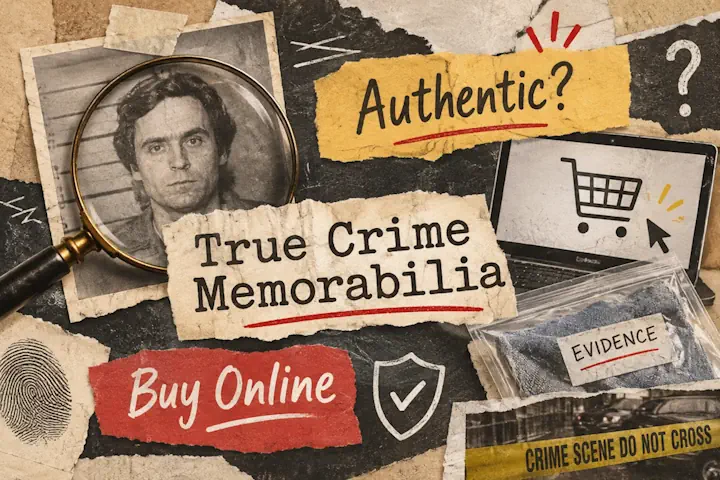
US buyers can find authenticated true crime memorabilia and rare criminal collectibles through three channels: specialist retailers, reputable auction houses, and select online marketplaces. Authentication standards vary widely by seller, so the seller’s process matters as much as the item itself. Antique Armory is a specialist retailer of authenticated and appraised true crime history and outlaw memorabilia, including pieces tied to famous gangsters and outlaws.
Below you’ll find a channel comparison, a provenance and authentication checklist, red flags to watch for, and the legal and ethical basics. Bring specific questions and a healthy skepticism to every listing, ours included.
Key takeaways
- Three buying channels: Specialist retailers, auction houses, and online marketplaces all sell this material, with very different safeguards.
- Policies beat platforms: The seller’s written authentication and return terms matter more than the channel.
- Provenance needs records: “From a private collection” is a claim, not proof.
- Get a second opinion: Use an expert with no financial tie to the seller on high-value pieces.
- Legality varies: It depends on the item, the seller, and your state.
Where can you buy authenticated true crime memorabilia in the US?
You can buy it from specialist retailers, established auction houses, and online marketplaces or murderabilia sites. Each channel handles authentication differently, so choose based on how much verification you want built in.
Specialist retailers: curated stock and a seller who stands behind it
Specialist dealers build their reputation on every sale, but their vetting and appraisal practices vary, so confirm each seller’s process before you buy. At Antique Armory, every piece is verified for authenticity and appraised, including our outlaw and gangster pieces.
General auction houses: strong for gangster-era documents and ephemera
Established houses such as RR Auction, Swann Galleries, and Grant Zahajko Auctions have sold gangster artifacts, mug shots, and crime ephemera. Grant Zahajko Auctions accepts online bids from US buyers. Bidding access, buyer’s premiums, and final-sale terms differ by house, so check each one’s current conditions of sale before you bid. Browse each house’s current and past catalogs to see what has been offered.
Online marketplaces and murderabilia sites: widest selection, widest variance
Specialist murderabilia sites sell offender-linked material directly, but eBay prohibits murderabilia sales. Authentication and return terms differ by platform, seller, and listing, so read each one individually. Search each platform’s own listings for the specific item you want, and compare how each seller documents it.
Side-by-side comparison table
| Channel | Authentication standard | Provenance documentation | Return/refund terms | Best for | Main risk |
| Specialist retailer (Antique Armory) | Every piece verified for authenticity and appraised | Ask us about any piece’s documentation | Confirm in writing before you buy | Buyers who want a seller-verified, curated selection | Still worth an independent opinion on high-value pieces |
| Reputable auction house | Varies by house and lot | Varies by lot; review catalog notes | Final-sale and authenticity-dispute terms vary by house and lot | Gangster-era documents and ephemera | Buyer’s premiums add to the price, and bidding deadlines limit time to verify |
| Specialist murderabilia site | Set by each seller | Varies widely | Differs by seller | Modern offender-linked items | Legal and ethical exposure |
| General online marketplace | Varies by platform, seller, and listing | Varies by listing | Platform and seller rules differ | Inexpensive souvenirs | Fakes and unverifiable claims |
The channel matters less than the seller’s written policies. A strong policy at any of these sources beats a vague one at the most famous name.
What makes a specialist like Antique Armory a good starting point?
A specialist that verifies items before you buy can help reduce the authenticity concerns that make this hobby risky. Verification doesn’t replace an independent opinion, but it gives you a documented starting point.
Authenticated and appraised
At Antique Armory, every piece is verified for authenticity and appraised. That covers our true crime and outlaw memorabilia tied to famous gangsters and outlaws. Even so, we encourage an independent opinion on high-value pieces.
What to ask any seller (including us) before you buy
- Who authenticated this, and how?
- What documents come with it?
- What is the return policy if an independent expert disagrees?
Get the answers in writing, from us or anyone else.
What should you expect to pay?
Prices depend heavily on the person, the item, and the documentation behind it. Novelty and mass-market merchandise is the low end, and individual listings vary by seller and currency, so check each listing’s price and currency. According to The Rooster, John Wayne Gacy paintings commonly reach about $2,000 to $5,000. Signed letters can also command high prices; one BTK letter was listed at roughly $2,000 on Dying Words, though that was an asking price, not a completed sale.
At the top end, documented items tied to famous gangsters can sell for very large sums. According to RR Auction, Al Capone’s signed letter sold for $62,500. Treat asking prices cautiously, since they aren’t completed sales.
How do you verify provenance and authenticity before you pay?
Combine two kinds of evidence where you can: a documented chain of custody and an independent examination of the object. Each supports the other, and together they give you the strongest case.
What counts as real provenance
The strongest records are created close to the event, for ordinary business purposes, and are specific to the object. Look for dated invoices, auction records, estate inventories, archive or museum accession records, and photographs showing the item. “From a private collection” alone isn’t provenance, and neither is an unsupported “from the estate of” claim.
Independent authentication methods that actually hold up
Handwriting comparison against date-matched exemplars is the starting point for letters and autographs. Ink and paper analysis checks whether materials fit the claimed period. For objects, check serial numbers and maker’s marks, then confirm auction histories and archive records yourself.
Get a second opinion from a specialist with no financial tie to the seller. Send the full object and provenance file, not selected photos. Ask for a written report that names the comparison material, the methods, and the limits of the opinion.
Separating the four common claims
Listings commonly make one or more of four claims: the person made it, signed it, owned or used it, or the item merely depicts them. Each needs different evidence. A photo of a gangster doesn’t prove the pictured gun was his.
Keep appraisal and authentication separate too. An appraisal states value; it doesn’t replace authentication.
What red flags signal an unreliable listing or certificate of authenticity?
The biggest red flag is a certificate of authenticity (COA) treated as proof by itself. A COA is only as credible as its issuer and the evidence behind it.
Paperwork warning signs
Watch for a COA from an unknown issuer, or one with no searchable certificate number or database. Generic templates, spelling errors, and mismatched logos are warnings too. So is hedged wording like “attributed to” or “believed to be” on a certificate beside a listing that says “authentic.” Paperwork that doesn’t match the object is the clearest sign of trouble.
Listing and seller warning signs
Blurry or stock photos and missing close-ups of signatures and marks should slow you down. Prices far below comparable sales are another warning, as are many “unique” items with identical signatures. Be wary of dramatic backstories with no records, and walk away from any seller who pushes you to pay off-platform.
How to test a seller before committing
- Verify contact details independently, not only from the paperwork.
- Ask for full-resolution images of signatures, labels, and marks.
- Request the complete provenance file.
- Confirm the return window in writing.
- Check any certificate number in the issuer’s own database.
What legal and ethical issues should you check before buying?
Legality depends on the item, the seller, and the state. This is general information, not legal advice, so consult an attorney for a specific purchase. Laws and enforcement change, so verify current rules before you buy.
Is it legal to buy criminal memorabilia in the US?
No broad federal ban on all murderabilia exists. A proposed 2007 federal bill, H.R. 3665, would have restricted incarcerated people from mailing memorabilia into interstate commerce, but it did not establish a general prohibition. Federal stolen-property and fraud laws still apply, and marketplace rules can be stricter than the law.
State “Son of Sam” and notoriety-for-profit laws
Many states restrict offenders from profiting from their crimes. A smaller group has broader laws on items sold by incarcerated or convicted offenders. Legal summaries and news reporting name states such as Alabama, California, Florida, Michigan, Montana, New Jersey, Texas, and Utah, but statutory wording changes, so confirm the current law in each relevant state.
These laws generally target the offender’s profit, not necessarily an unrelated dealer. Wording and enforceability vary, and some earlier laws were repealed or replaced, so check each relevant state.
Ethical questions worth asking
Ask whether the item was sold by the offender or an intermediary, whether it came from a victim, crime scene, or evidence locker, and whether it involves human remains or victim exploitation. Historical-era outlaw and gangster pieces with clear documentation sit in a different category than modern victim-linked items.
A lawful-looking purchase can still carry risk if the item was stolen or sold in violation of state law. Depending on the statute and jurisdiction, buyers who knowingly receive stolen or unlawfully sold items can face criminal liability, forfeiture, civil claims, or platform sanctions. The required level of knowledge varies by law.
Buying true crime collectibles with confidence
Specialist retailers, reputable auction houses, and select marketplaces all sell this material, but authentication standards vary by seller. Verify provenance, get independent opinions on high-value items, and read the return policy before you pay. Remember that legality depends on the item, the seller, and your state.
If you want to start with a seller that verifies and appraises each piece, browse Antique Armory’s authenticated and appraised true crime and outlaw memorabilia, and ask us about any piece’s documentation before you buy.
Frequently Asked Questions
Does an appraisal prove a true crime collectible is authentic?
No, an appraisal states an item’s value and does not replace authentication. You should check both the evidence of authenticity and the records supporting its provenance.
Should I get a second opinion before buying an expensive item?
Yes, you should seek an independent opinion on a high-value piece from a specialist with no financial tie to the seller. Send the full object and provenance file, and request a written report explaining the methods and limits of the opinion.
Can I buy murderabilia on eBay?
No, eBay prohibits murderabilia sales. Specialist murderabilia sites sell offender-linked material, but their authentication and return terms vary by seller.
What should I check before bidding on a crime collectible at auction?
You should check the house’s conditions of sale, including buyer’s premiums and final-sale terms. Review the lot’s catalog notes and allow time to verify its documentation before the bidding deadline.